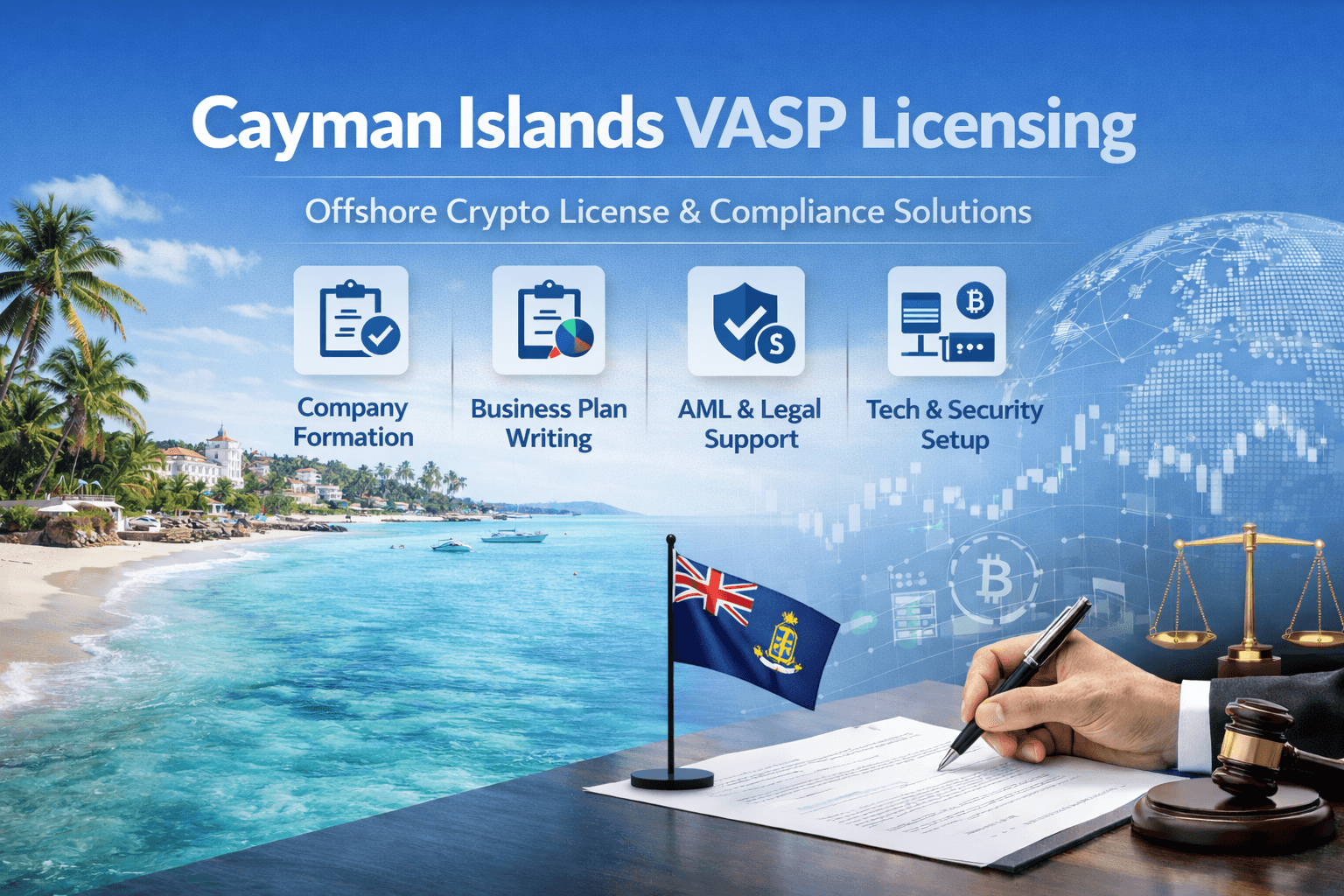
Cayman Islands VASP License: Complete Guide to Crypto Licensing with CIMA (2026)
Updated: March 2026 | Author: Zitadelle AG Regulatory Team
⚠️ 2025–2026 Regulatory Updates:
The Cayman Islands VASP framework has undergone its most significant structural expansion since the regime's launch in 2020. Three key developments define the 2026 landscape:
1. Phase 2 Licensing Regime — effective 1 April 2025. Virtual asset custodians and virtual asset trading platform operators must now obtain a full VASP License from CIMA — not merely registration. Existing registered VASPs providing custody or trading services had 90 days (until July 1, 2025) to apply for a license. Operating without a license is a breach of the VASP Act and may result in penalties, cease-and-desist orders, and registration cancellation.
2. Market Conduct Rule (MC-RSOG) — issued February 2026. CIMA issued a binding Rule and Statement of Guidance on Market Conduct for all VASPs, introducing explicit requirements for conflicts of interest management, client asset protection, complaints handling, transparent pricing, and conduct standards across the full client lifecycle.
3. CIMA Enforcement is active. CIMA cancelled the registration of AC Holding Limited in June 2025 for multiple compliance deficiencies. A November 2025 thematic review found that 40% of reviewed VASPs had inadequate custody policies and significant gaps in corporate governance, cybersecurity, and business continuity. CIMA has made clear that compliance is a continuous, monitored obligation — not a point-in-time exercise.
Contact Zitadelle AG for guidance on the current CIMA VASP framework.
The Cayman Islands VASP License, issued by the Cayman Islands Monetary Authority (CIMA), has established itself as one of the world's most strategically credible authorizations for digital asset service providers. With a sophisticated, internationally respected regulatory framework, zero-tax regime, English common-law legal infrastructure, and direct access to the global institutional financial ecosystem — including hedge funds, private equity, and institutional investors already domiciled in the Cayman Islands — a Cayman VASP authorization provides a combination of regulatory quality and commercial positioning that few offshore jurisdictions can match.
As of February 2026, only 19 VASPs are registered or licensed with CIMA — making this one of the most exclusive and credibility-signaling digital asset registries globally.
Zitadelle AG is a specialist regulatory consultancy providing end-to-end support for virtual asset service providers seeking Cayman Islands VASP registration or licensing — from corporate structuring and business plan preparation through CIMA submission, key personnel placement, and ongoing compliance management. This guide covers everything you need to know about the Cayman Islands crypto license framework in 2026, including the material changes introduced since April 2025.
Businesses evaluating a Cayman Islands VASP License often compare it against other leading offshore jurisdictions including the Mauritius VASP License and the Seychelles VASP License. Each offers distinct regulatory frameworks, timelines, capital requirements, and banking access profiles. Zitadelle AG advises on all three and can help you select the optimal jurisdiction for your business model, target markets, and institutional strategy.
Frequently Asked Questions About the Cayman Islands VASP License
What Is a Cayman Islands VASP License?
A Cayman Islands VASP License is a regulatory authorization issued by the Cayman Islands Monetary Authority (CIMA) under the Virtual Asset (Service Providers) Act (2024 Revision) (VASPA) and its 2025 amendments. It authorizes virtual asset service providers to legally operate in or from the Cayman Islands, providing services including:
Virtual asset exchange (crypto-to-fiat and crypto-to-crypto trading)
Virtual asset custody services (holding or managing digital assets on behalf of clients)
Virtual asset wallet services
Token issuance and distribution
Transfer and settlement of virtual assets
Payment and settlement services involving virtual assets
Important: Following the Phase 2 commencement on 1 April 2025, there are now two distinct authorization tiers under the VASPA:
VASP Registration — for virtual asset service providers not providing custody services or operating a trading platform. Simpler process, lower fees, focused primarily on AML/CTF compliance.
VASP License — mandatory for all virtual asset custodians and virtual asset trading platform operators. More rigorous requirements, higher fees, enhanced governance and prudential standards.
Any entity providing both registration-type and license-type services under the VASPA requires only a license (not both).
What Changed Under the Phase 2 Licensing Regime (April 2025)?
The Phase 2 commencement on 1 April 2025 represents the single most important structural change in the history of the Cayman Islands VASP framework.
What changed:
Virtual asset custodians and trading platform operators now require a full VASP License from CIMA — registration alone is insufficient
At least three directors are now required for licensed entities (including at least one independent director)
Enhanced prudential requirements including segregation of client assets, capital adequacy expectations, and documented internal control systems
Enhanced cybersecurity obligations — detailed cybersecurity policies, incident reporting mechanisms, and risk management frameworks
Applications must be submitted through CIMA's REEFS (Regulatory Enhanced Electronic Forms Submission) online platform
Application checklist requirements formalized under Schedule 1A of the Virtual Asset (Service Providers) (Amendment) Regulations 2025
What has not changed:
Non-custodial, non-trading-platform VASPs may still operate under registration (not full licensing)
CIMA's zero-tax regime and Cayman Islands' FATF-compliant status remain intact
All applications — registration and licensing — are submitted through REEFS
Enforcement note: CIMA cancelled the VASP registration of AC Holding Limited on 5 June 2025 for failing to provide documents to CIMA, failing to implement AML systems and procedures, and breaching CIMA's Rules on Corporate Governance and Internal Controls. CIMA has explicitly stated that it will take decisive enforcement action where breaches are not remedied.
What Did CIMA's Thematic Review Find — and Why Does It Matter for Applicants?
In November 2025, CIMA published findings from its thematic desk-based review of 11 regulated VASPs conducted from September 2024 to February 2025. These findings are the most important public signal available about CIMA's current supervisory expectations and application standards.
Key findings — areas where VASPs were found deficient:
Inadequate virtual asset custody policies — 40% of reviewed VASPs had inadequate policies for virtual asset custody services. Even acknowledging that the Rule and Statement of Guidance for Virtual Asset Custodians and Trading Platforms was only published in December 2024, CIMA's standard is clear.
Deficiencies in business continuity planning — inadequate BCPs that had not been approved by the board, had not been tested, and did not comply with CIMA's Statement of Guidance. A BCP that exists on paper but is never tested is not compliant.
Inadequate risk assessments — customer risk assessments that were not up-to-date, not adequately documented, or did not demonstrate that all relevant risk factors had been considered (jurisdiction of operation, transaction types, delivery channels).
Corporate governance gaps — weak board oversight, unclear reporting lines, and inadequate oversight of outsourced functions.
Cybersecurity weaknesses — CIMA found significant gaps in technology governance and cyber risk management.
What this means for new applicants: CIMA's application standards reflect these supervisory findings. A VASP application that does not demonstrate robust custody policies, a tested BCP, comprehensive risk assessments, sound corporate governance, and credible cybersecurity architecture will not succeed. Zitadelle AG builds these elements into every application it prepares.
What Is the New CIMA Market Conduct Rule (February 2026)?
In February 2026, CIMA issued a binding Rule and Statement of Guidance on Market Conduct for VASPs (MC-RSOG), applicable to all VASPs authorized under the VASP Act — both registered and licensed.
The MC-RSOG introduces explicit requirements for:
Honesty and integrity in all client interactions across the full client lifecycle — including client communications, transaction execution, and ongoing servicing
Conflicts of interest management — robust frameworks for identifying, managing, and disclosing conflicts
Client asset protection — including segregation requirements and transparency about asset custody arrangements
Complaints handling procedures — formalized, timely, and documented
Transparent pricing — clear, fair, and non-misleading fee and pricing disclosure
Confidentiality — appropriate information barriers and data handling
The MC-RSOG supplements the existing Rule on Virtual Asset Custodians and Virtual Asset Trading Platforms (Custody and VATP R&SOG) originally published in December 2024, which was also updated in February 2026.
Impact on applications: All new VASP applications must demonstrate the governance and operational infrastructure to comply with the MC-RSOG from the outset. CIMA will assess this during its review. Zitadelle AG integrates MC-RSOG compliance into all application documentation it prepares.
Two-Tier Authorization: Registration vs. License
Understanding which tier applies to your business model is the most important first step in the Cayman VASP process.
Factor | VASP Registration | VASP License |
|---|---|---|
Who needs it | Non-custodial VASPs; services not involving custody or trading platform operations | Virtual asset custodians; virtual asset trading platform operators |
Minimum directors | Not specified (governance appropriate to business) | At least 3 (including at least 1 independent) |
Capital requirement | Resources commensurate with operations | Min. USD 100,000 paid-up share capital; higher for custody/exchange operations |
Application fee | KYD 1,000 | KYD 1,000 (application) + license fees on approval |
Annual fees | KYD 1,500–5,000 (depending on revenue / activity) | KYD 5,000–200,000 (depending on service type and scale) |
AML/CTF obligations | Full (FATF-aligned) | Full (FATF-aligned) + enhanced custody/trading platform conduct rules |
Timeline | 3–6 months | 4–10 months |
REEFS submission | Yes | Yes |
If your business model involves both registration-type and license-type activities, a license is required (not both).
Full Requirements for a Cayman Islands VASP License (2026)
Corporate and Governance Requirements
Registered office: Physical registered office in the Cayman Islands is required for all VASP entities.
Directors:
Minimum 3 directors for licensed entities (post-April 2025 Phase 2 requirement)
At least 1 independent director
All directors and senior officers must satisfy CIMA's fit-and-proper person criteria — demonstrating integrity, competence, and financial soundness
Directors and controllers must pass CIMA's fit-and-proper vetting process; this is a core approval criterion, not a formality
CIMA-approved director: At least one director must be approved by CIMA for custodial service activities.
100% foreign ownership permitted — no Cayman nationality or residency requirement for shareholders, subject to fit-and-proper assessment.
Key Personnel — Local Presence Requirements
AML Officer (MLRO): Must be based in the Cayman Islands. This is a non-negotiable requirement — a non-resident AML officer will not satisfy CIMA's standards.
Compliance Officer: Required; may be the same person as the MLRO for smaller operations.
Zitadelle AG can source pre-vetted, CIMA-experienced AML officers and compliance professionals through our HR network and HRFinease platform.
Capital Requirements
There is no single fixed minimum capital requirement applicable to all VASP activities. However:
Minimum paid-up share capital of USD 100,000 is the established baseline expectation
Higher capital may be required — and is expected — for custodial or exchange operations
CIMA applies a risk-based capital model; undercapitalization is one of the most common reasons for application failure
Financial projections must demonstrate sufficient working capital to sustain operations; realistic financial modeling is critical
AML/CTF Compliance Framework
CIMA requires a comprehensive, operationally implemented AML/CTF framework aligned with FATF standards. This must include:
Full customer due diligence (CDD) and enhanced due diligence (EDD) procedures
Customer risk assessments — specific, documented, up-to-date, and reflecting all risk factors
Transaction monitoring framework and suspicious activity reporting procedures
Sanctions screening program
Travel Rule compliance architecture for virtual asset transfers
Appointment of a local MLRO
AML/CTF training program for all relevant staff
Documented AML/CTF policies reviewed and approved by the board
CIMA's thematic review found that generic, template-based AML programs are easily identified and rejected. Programs must be tailored to the specific business model.
Business Plan
A CIMA-ready business plan must include:
Business model and regulated activities description
Revenue model and financial projections (3-year minimum)
Market and competitive analysis
Target customer profile and risk assessment
Technology infrastructure overview
Governance and management structure
Compliance and risk management framework
CIMA has made clear that weak business plans are a primary reason for application failure.
Technology and Cybersecurity
CIMA expects sound technology governance across all licensed VASPs:
Documented cybersecurity policies and framework
Secure wallet and custody infrastructure (for custodial services)
Data integrity, encryption, and access control standards
Business continuity and disaster recovery planning — tested, board-approved, and independently reviewed
Incident reporting mechanisms and operational resilience procedures
IT risk monitoring and regular testing
The thematic review found significant cybersecurity and BCP deficiencies — CIMA will scrutinize these areas closely in all new applications.
Documentation Checklist
Applications are submitted through CIMA's REEFS portal and must include:
Corporate documentation:
Certificate of incorporation
Memorandum and Articles of Association
Shareholder and beneficial ownership records
Virtual asset declaration
AML/CTF inherent risk form
Personal documentation (for all directors, senior officers, and key UBOs):
Personal declarations
Reference letters
Police clearance certificates
Operational documentation:
Comprehensive business plan
AML/CFT policy and procedures
Customer onboarding and KYC/KYB procedures
Transaction monitoring protocols
Internal controls documentation
Technology architecture and cybersecurity framework
Business continuity plan
Legal documentation:
Legal opinion from a Cayman Islands-licensed attorney confirming regulatory classification, scope of activities, and alignment with CIMA requirements
Auditor consent letter (Cayman Islands-based auditor)
Financial documentation:
Capital structure and paid-up share capital evidence
3-year financial projections
A Cayman VASP application typically comprises 50–100+ documents. CIMA does not process incomplete applications — incomplete submissions restart the review clock.
Application Process and Timeline
Application Steps
Step 1 — Regulatory scoping and classification Determine whether your business model requires VASP registration or a full VASP license. This is the most consequential decision in the entire process — over-licensing and under-licensing both carry costs. Zitadelle AG conducts this assessment as the first step of every engagement.
Step 2 — Corporate structuring and incorporation Cayman Islands company formation, governance framework design, director appointments, and REEFS portal registration. Coordinated in parallel with documentation preparation.
Step 3 — Documentation preparation Business plan, AML/CTF framework, risk assessment, technology architecture, legal opinion, and all supporting personal and corporate documentation. This is the most time-intensive phase — and the one where application quality is determined.
Step 4 — REEFS submission Submission of the complete application package through CIMA's REEFS platform. Both directors must sign declarations confirming they have read and understand the VASPA, the Regulations, and the Anti-Money Laundering Regulations 2025.
Step 5 — CIMA review and queries CIMA conducts a detailed review. Query responses can determine approval outcomes — this phase requires experienced regulatory engagement, not administrative correspondence.
Step 6 — Approval and post-license setup On approval, CIMA issues written notification and the applicant pays the relevant license fees. Post-authorization: compliance officer onboarding, KYC/AML technology integration, and ongoing CIMA reporting setup.
Timeline
Application type | Typical end-to-end timeline |
|---|---|
VASP Registration | 3–6 months |
VASP License (custody / trading platform) | 4–10 months |
Timeline is primarily determined by application quality. Fast approvals come from strong preparation — not fast submission. CIMA does not process incomplete applications.
Annual fees are due by 15 January each year. Late payment incurs a surcharge of one-twelfth of the annual fee for every month (or part-month) that payment is late after 15 January.
Tax and Structural Advantages
The Cayman Islands' tax regime is one of the most compelling in the world for digital asset businesses:
0% corporate income tax
0% capital gains tax
0% withholding tax
0% VAT
No income tax on dividends, interest, or royalties
These benefits are not time-limited in the way the AIFC's zero-tax guarantee is — they reflect the Cayman Islands' fundamental constitutional structure as a British Overseas Territory with no direct taxation.
CARF (Crypto Asset Reporting Framework) — effective January 1, 2026: The Cayman Islands implemented CARF regulations effective January 1, 2026, requiring Cayman Financial Institutions (including VASPs) to report crypto asset transaction data to the Tax Information Authority (TIA). First reports are expected in 2027. This does not create a tax liability for Cayman entities, but requires reporting infrastructure and a designated principal point of contact in the Cayman Islands.
Tokenized funds — regulatory clarity: The Virtual Asset (Service Providers) (Amendment) Bill 2026, together with the Mutual Funds (Amendment) Bill 2026 and Private Funds (Amendment) Bill 2026, clarifies that tokenized fund interests (digital equity tokens and digital investment tokens issued by regulated funds) do not constitute "virtual asset issuance" under the VASP Act — resolving a significant area of uncertainty for fund managers and institutional digital asset structures.
Why the Cayman Islands for an Offshore VASP?
Exclusive Registry — Only 19 VASPs
As of February 2026, only 19 virtual asset service providers are registered or licensed with CIMA. This is one of the smallest, most selective VASP registries of any regulated jurisdiction globally. A Cayman VASP authorization is not a commodity license — it is a credibility signal that opens doors with institutional counterparties, prime brokers, custodians, and fund administrators that are themselves Cayman-domiciled.
Institutional Ecosystem Alignment
The Cayman Islands is the world's leading jurisdiction for hedge funds, private equity, and alternative investment vehicles. More than 12,000 funds are registered with CIMA. A VASP operating from the Cayman Islands sits within this institutional ecosystem — with direct access to fund administrators, prime brokers, auditors, and legal counsel already fluent in Cayman law and already working with digital asset structures.
FATF-Compliant and Not Blacklisted
The Cayman Islands is not on any international financial blacklists, maintains FATF-compliant AML/CTF standards, and is preparing for its CFATF 5th Round Mutual Evaluation scheduled for late 2027. This preparation is driving further regulatory enhancements in the VASP sector — strengthening the jurisdiction's long-term regulatory credibility.
Common-Law Legal System
All CIMA regulation is governed under English common law, with disputes resolvable through the Grand Court of the Cayman Islands. This provides a stable, internationally recognized legal framework familiar to institutional counterparties worldwide.
Banking Access
A CIMA-licensed VASP has materially better access to banking relationships — both in the Cayman Islands and internationally — than unlicensed or registration-only operators. CIMA's regulatory imprimatur signals compliance credibility to correspondent banks, payment processors, and institutional service providers.
Cayman Islands VASP vs. Mauritius VASP vs. Seychelles VASP: How to Choose
Factor | Cayman Islands | Mauritius | Seychelles |
|---|---|---|---|
Regulator | CIMA | FSC Mauritius | FSA Seychelles |
Registry size | ~19 (exclusive) | Larger | Larger |
Min. capital | USD 100,000+ | Varies by activity | Varies by activity |
Timeline | 4–10 months | 3–6 months | 2–4 months |
Annual fees | KYD 1,500–200,000 | Varies | Lower |
Tax | 0% | 0–15% (on GBC income) | 0% |
Institutional credibility | Very high | High | Moderate |
Banking access | Strong (institutional) | Good | Moderate |
Best suited for | Institutional, exchange, custody | Cross-jurisdictional, Africa/Asia access | Leaner operations, faster setup |
Zitadelle AG advises on all three jurisdictions and can design the optimal offshore VASP structure for your business model, capitalization, and target market.
How Zitadelle AG Supports Your Cayman Islands VASP Application
Zitadelle AG is a boutique regulatory consultancy with specialist expertise in offshore VASP licensing across the Cayman Islands, Mauritius, Seychelles, and other jurisdictions. Our Cayman Islands VASP service includes:
Regulatory scoping and classification — determining whether your business model requires VASP registration or a full license, and what combination of activities is in scope of the VASP Act.
Corporate structuring and Cayman company formation — company incorporation, governance framework design, director identification and vetting, and REEFS portal setup.
Business plan preparation — a CIMA-ready business plan built around your specific business model, financial projections, and risk profile. Not a template — a document designed for approval.
AML/CTF compliance framework — bespoke AML/CTF policies, customer risk assessment methodology, transaction monitoring framework, Travel Rule compliance architecture, and staff training program. Tailored to your specific business — CIMA identifies and rejects template-based programs.
Technology and cybersecurity documentation — cybersecurity policies, BCP (board-approved and tested), IT risk monitoring framework, incident reporting procedures, and custody security architecture.
Legal opinion coordination — working with our Cayman Islands local legal partners to prepare the required regulatory classification opinion.
Key personnel sourcing — identification, assessment, and onboarding of Cayman-based AML officers through HRFinease and our professional network.
Full REEFS application management — document assembly, REEFS submission, and management of CIMA's review process including query responses.
Market Conduct compliance — all application documentation is built to satisfy the February 2026 MC-RSOG from the outset.
Post-authorization compliance support — ongoing AML/CTF program maintenance, CIMA annual reporting, fee payment management, CARF reporting setup, and regulatory change monitoring.
Tokenized fund structuring advisory — for fund managers and institutional clients seeking to issue tokenized interests within the updated Cayman fund framework.
Frequently Asked Questions (FAQ)
What is the difference between VASP registration and a VASP license in the Cayman Islands? Since April 1, 2025, virtual asset custodians and trading platform operators must obtain a full VASP license. Other VASP activities (non-custodial, non-trading-platform) still require only VASP registration. The license has higher capital, governance, and documentation requirements. If your business provides both registration-type and license-type services, only a license is needed.
How many VASPs are currently licensed with CIMA? As of February 4, 2026, 19 VASPs are registered or licensed with CIMA — making this one of the most exclusive digital asset registries globally.
What is the minimum share capital for a Cayman Islands VASP license? The established minimum is USD 100,000 paid-up share capital, with higher capital expected for custody and exchange operations. CIMA applies a risk-based capital model — undercapitalization is a leading cause of application failure.
Do I need a local director or compliance officer? Yes. A Cayman Islands-based AML Officer (MLRO) is required. At least one CIMA-approved director is required for custodial activities. Licensed entities must have at least 3 directors, including at least 1 independent.
How long does CIMA VASP licensing take? VASP registration: 3–6 months. Full VASP license: 4–10 months. Timeline depends primarily on documentation quality. CIMA does not process incomplete applications.
Can a foreign company own 100% of a Cayman Islands VASP? Yes. 100% foreign ownership is permitted, subject to CIMA fit-and-proper assessments of directors, senior officers, and UBOs.
What are the annual fees for a Cayman Islands VASP? Annual fees range from KYD 1,500–5,000 for VASP registration and KYD 5,000–200,000 for VASP licenses, depending on service type and revenue scale. Fees are due by January 15 each year. Late payment incurs a monthly surcharge.
Does CIMA enforce actively? Yes. CIMA cancelled AC Holding Limited's VASP registration in June 2025 and has signaled through its November 2025 thematic review that it will continue enforcement against non-compliant VASPs. CIMA's enforcement posture has shifted toward formal accountability.
What is the CARF and how does it affect Cayman VASPs? The Crypto Asset Reporting Framework (CARF) took effect in the Cayman Islands on January 1, 2026. Cayman VASPs must now collect and report crypto asset transaction data to the Cayman Tax Information Authority (TIA), with first reports expected in 2027. This does not create a tax liability but requires reporting infrastructure.
Ready to Establish Your VASP in the Cayman Islands?
The Cayman Islands VASP framework in 2026 is more demanding — and more valuable — than at any previous point in its history. The Phase 2 licensing regime, the new Market Conduct Rule, and CIMA's active supervision have raised the bar substantially. But that elevation is precisely what gives a Cayman VASP authorization its institutional credibility. Among only 19 registered entities, yours would stand as a genuine signal of regulatory quality.
Contact Zitadelle AG today for a free, no-obligation consultation. We will assess your business model, determine whether registration or full licensing applies, and design the most efficient path to CIMA authorization.
📞 Call / WhatsApp / Telegram: +357 96 649654 🌐 Website: www.zitadelleag.com 📅 Book a Free Consultation
This article is provided for informational purposes only and does not constitute legal or regulatory advice. CIMA regulatory requirements are evolving. Always consult a qualified advisor — such as Zitadelle AG — before initiating a licensing process. Last updated: March 2026.
Compare Other Offshore VASP Jurisdictions:
Related Services from Zitadelle AG: