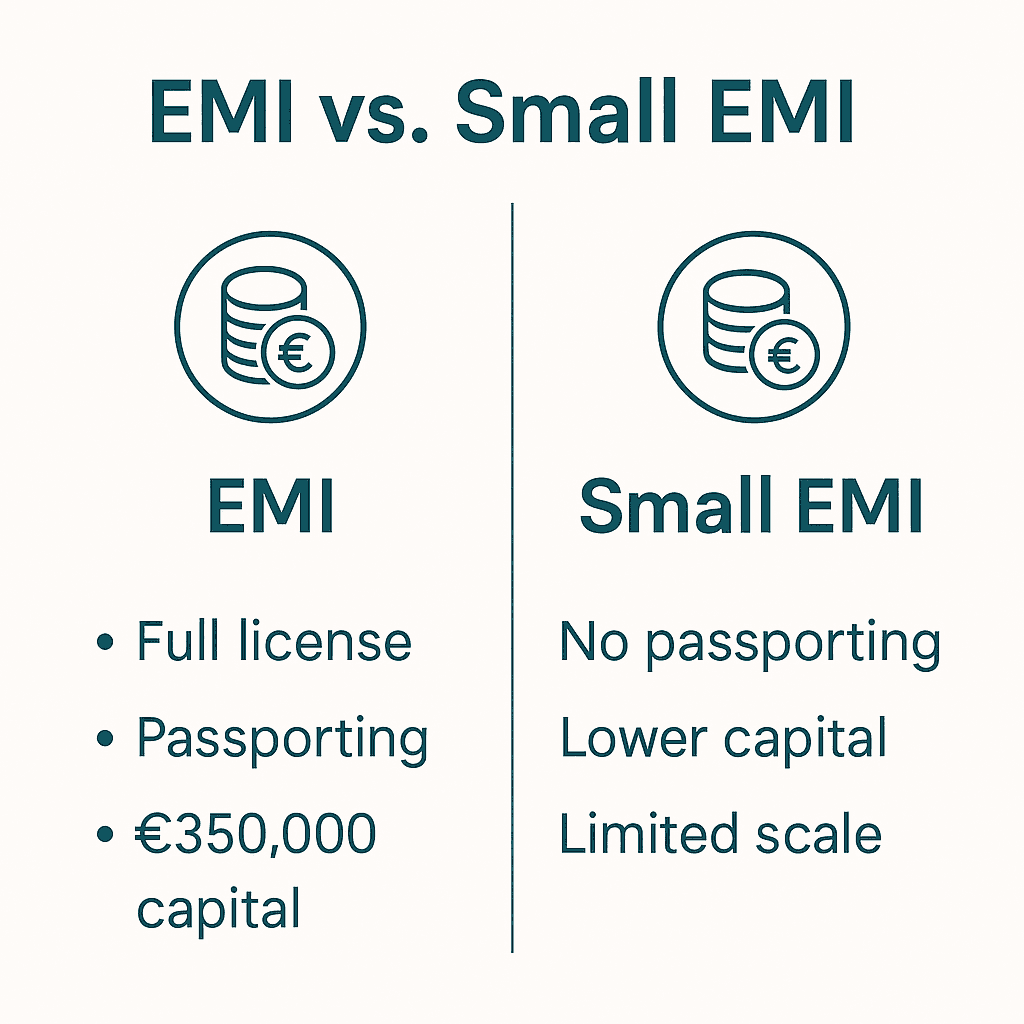
In the European Union, Electronic Money Institutions (EMIs) can be authorised under two different regimes:
1. Full EMI Authorisation
This is a full license under the Electronic Money Directive (2009/110/EC) and allows a company to:
Issue electronic money (e-money)
Provide payment services (like those under the Payment Services Directive – PSD2)
Passport its services across the EEA (European Economic Area)
Hold client funds and issue payment instruments (e.g. prepaid cards, wallets)
Key Requirements typically include:
Minimum capital: €350,000
Robust governance and risk management
Anti-money laundering (AML) policies and procedures
Business plan and financial projections
External audit and compliance requirements
Fit and proper assessment of directors and shareholders
2. Small EMI Authorisation
This is a light version of the EMI license, designed for smaller e-money issuers operating on a limited scale only in their home country.
Key Differences and Limitations:
No passporting: Cannot offer services in other EEA countries.
Lower capital requirement: Usually much less than €350,000 (e.g., as low as €50,000 or depending on local rules).
Turnover limits: Annual average outstanding e-money is often limited (e.g., less than €5 million).
Simplified compliance: Reduced requirements for governance, AML, and reporting.
No access to central banks’ settlement systems
Summary Table
Summary Table | ||
Feature | Full EMI | Small EMI |
Passporting | Yes | No |
Capital Requirement | €350,000 | Lower (varies by country) |
Client Money Safeguarding | Full safeguarding required | May have simplified rules |
Supervision & Audits | Full | Light |
Business Scale | Unlimited | Capped (e.g., ≤ €5M e-money) |
AML Compliance | Full framework | Simplified |